9 April 2026
On 2 April 2026, the Constitutional Court of Ukraine hosted a specialist event focusing on the specific features of constitutional review in the Czech Republic. The keynote speaker at the online educational lecture was a judge of the Constitutional Court of the Czech Republic and an expert in constitutional law Zdeněk Kühn.
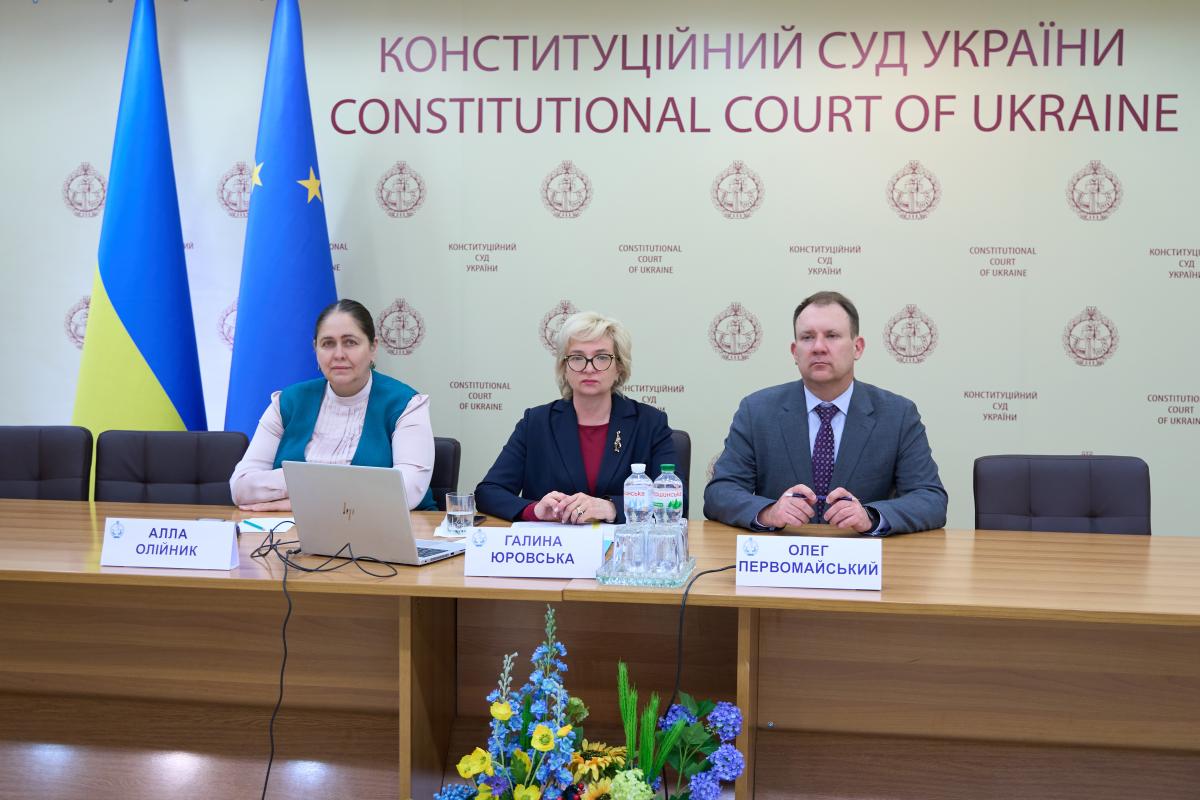
The event was attended by judges of the Constitutional Court of Ukraine Alla Oliinyk, Oleg Pervomayskyi and Galyna Yurovska, as well as representatives of the National School of Judges of Ukraine, practising lawyers, judges, prosecutors, attorneys, academics, lecturers, postgraduate students, law students and the youngest researchers – students of the Junior Academy of Sciences.
During his speech, judge Zdeněk Kühn outlined the historical stages in the development of the Czech justice system, the origins of which date back to the formation of the Czechoslovak Republic. As early as the 1920s, the country had a specialised judicial body responsible for reviewing the constitutionality of laws. Having analysed the dynamics of the judicial system’s development after 1989, the speaker emphasised that since the establishment of the Constitutional Court of the Czech Republic in July 1993, this institution has operated as a specialised body, independent of the system of courts of general jurisdiction.
The theoretical part of the lecture focused on Hans Kelsen’s concept of the European model of constitutional review. The speaker outlined the main principles of this model, highlighting the key difference from the American model, which lies in the fact that constitutional justice is administered not by courts of general jurisdiction, but by a single specialised body functioning as a “negative legislator”, vested with the power to annul unconstitutional acts. This model, first implemented in Austria and Czechoslovakia in 1919–1920, became the fundamental basis for most constitutional courts in modern Europe.
The lecturer devoted particular attention to analysing two approaches to the institution of constitutional complaints. The first approach is the “court of laws” model, under which the subject of review is exclusively legislative acts (laws), rather than specific court decisions. This system is characteristic, in particular, of Bulgaria, Italy, Latvia, Poland, Romania and France.
The second approach, found in particular in Spain, Germany, the Czech Republic, as well as Slovakia (since 2000) and Hungary (since 2011), is conventionally referred to as the “super supreme court” model. This model provides for the possibility of appealing against decisions of the courts within the judicial system. This means that the constitutional court is empowered to review whether ordinary courts have violated fundamental human rights in their decisions and, if violations are found, to quash such verdicts. Despite offering the highest level of protection for individual rights, this model places a significant burden on judges and gives rise to debates regarding the division of powers between the Constitutional and Supreme Courts.
In conclusion, Zdeněk Kühn analysed the current challenges faced by constitutional courts in Central and Eastern European countries. The judge expressed concerns regarding the risks of the politicisation of justice and emphasised that the independence of the courts is a vital safeguard for the protection of the democratic order and the rule of law.
In response to questions from colleagues, Zdeněk Kühn provided statistical data on the trends in the number of applications received by the Constitutional Court of the Czech Republic and the number of cases currently pending before it.
At the conclusion of the event, the judges of the Constitutional Court of Ukraine expressed their sincere gratitude to Zdeněk Kühn for his informative and in-depth lecture, which provided a deeper understanding of the Czech experience of constitutional review. They also thanked their European partners for their constant support and assistance in the professional exchange of experience, which is extremely valuable for the further development of Ukrainian constitutional jurisdiction.
A video recording of the lecture is available at: https://youtu.be/6EotelBNDOc