
19.01.2026
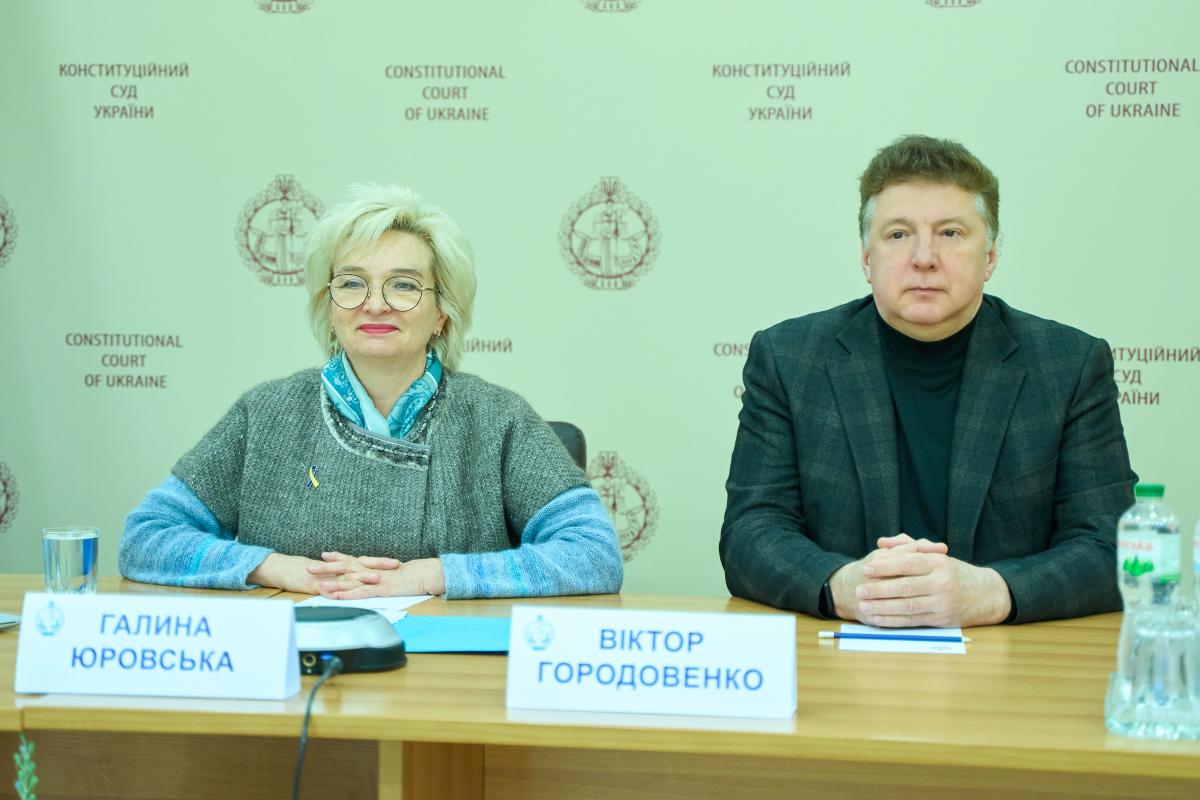
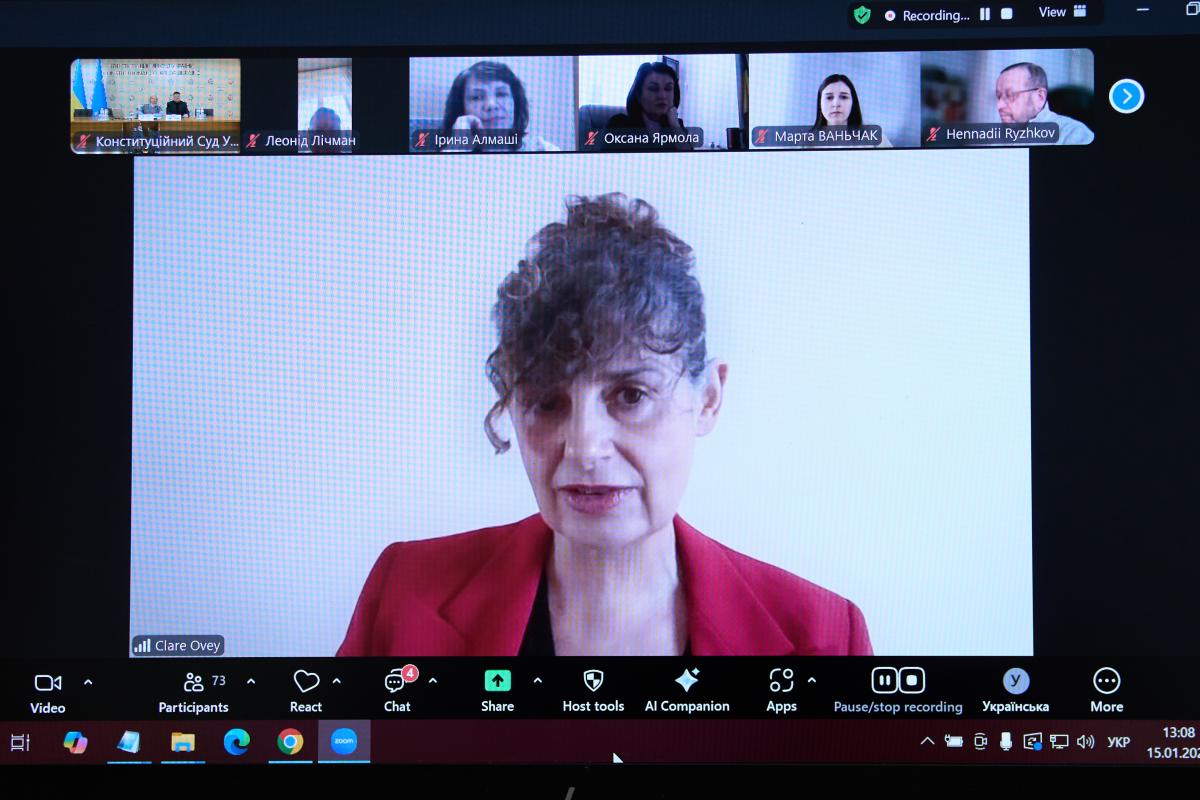
For three quarters of a century, the Council of Europe has been a powerful key international organisation whose core values form the basis of Ukraine's constitutional order: genuine democracy, respect for human rights and the rule of law. This was emphasised by judges of the Constitutional Court of Ukraine Viktor Gorodovenko and Galyna Yurovska during a lecture given by Clare Ovey, Director of Human Rights, the Directorate General of Human Rights and Rule of Law (DGI). The judges of the Constitutional Court of Ukraine noted the successful and long-standing cooperation between the Constitutional Court of Ukraine and the Council of Europe and expressed their gratitude for the continuous and consistent support, which has become particularly important today, at a very difficult time for Ukraine and Ukrainians.
The event was attended by representatives of the National School of Judges of Ukraine, judges, prosecutors, lawyers, academics, postgraduate students, teachers, students of higher education establishments, and students of the Junior Academy of Sciences of Ukraine.
During her lecture, Clare Ovey focused on the activities of the Council of Europe, which Ukraine joined 30 years ago. She noted that the Council of Europe's activities are based on a strategic triangle (standards – monitoring – technical support), the practical implementation of which is ensured by the Directorate General of Human Rights and Rule of Law through its specialised departments and project offices.
Particular attention was paid to Ukraine's key achievements during its 30 years of membership in the Council of Europe. The speaker noted that during this period, Ukraine had implemented judgements in 1,518 cases, 145 of which were leading cases. Among the achievements are constitutional and legislative reforms to ensure the independence of the judiciary, bringing the judicial discipline and career system into line with Council of Europe standards (the case of Oleksandr Volkov v. Ukraine), and strengthening human rights guarantees. Criminal procedural legislation has also been reformed, a system of free legal aid and prisoner registration has been created, and a mechanism for reviewing life sentences has been introduced, among other things.
The speaker also emphasised the important role of the Constitutional Court of Ukraine in this process, highlighting its significant work in promoting knowledge of the convention system (the standards of the European Convention on Human Rights) among the judicial community and citizens, and reducing the workload of the ECHR. In this context, she cited examples of decisions in which the Constitutional Court of Ukraine recognised certain legislative provisions as unconstitutional. In particular, she referred to the abolition of the automatic extension of preventive measures in the form of detention and the introduction of a mechanism for reviewing life sentences.
The speaker noted that the effectiveness of the implementation of ECHR judgements directly depends on the existence of effective national mechanisms, a reliable institutional base and coordinated interaction between all branches of government, which ensure compliance with human rights standards.
It was also emphasised that many cooperation projects are implemented within the framework of the Council of Europe's Action Plan for Ukraine “Resilience, Recovery and Reconstruction” (2023-2026).
Clare Ovey noted that strengthening constitutional justice is a key area of the Council of Europe's support for the rule of law in Ukraine. This support focuses on strengthening the capacity of the Constitutional Court of Ukraine to consistently apply European human rights standards, drawing on the case law and methodology of the ECHR and, where appropriate, the Court of Justice of the European Union. She highlighted the establishment of an institutional partnership between the constitutional courts of Ukraine and Latvia, which has enabled a direct exchange of experience and ongoing judicial dialogue. In addition, the Council of Europe supports judicial integrity, in particular by assisting in the development, adoption and practical implementation of the Rules of Professional Conduct for Judges of the Constitutional Court of Ukraine.
She also stressed that work is continuing to improve transparency and access to constitutional justice, in particular to improve vulnerable groups' understanding of the constitutional complaint mechanism. An important aspect is the introduction of tools to monitor the implementation of Constitutional Court decisions. Particular attention is paid to the practical application of ethical standards, providing recommendations on preventing conflicts of interest and ensuring integrity guarantees.
The speaker also emphasised that the Council of Europe supports the justice reform programme in Ukraine through a number of projects in the judicial, criminal and law enforcement spheres. She stressed that the Organisation remains a strategic and reliable partner of Ukraine in creating and strengthening national systems for the protection and support of persons affected by the war.
Інформує відділ комунікацій КСУ та правового моніторингу
